
I Saw the Light!
Actually, I Didn't, but I Plan to

(116)
What do you know about light bulbs?
I can’t stand a naked light bulb, any more than I can a rude remark or a vulgar action. (Tennessee Williams)
Keep a good head and always carry a light bulb. (Bob Dylan)
How many Zen masters does it take to screw in a light bulb? The plum tree in the garden! (Brad Warner)
I never once failed at making a light bulb. I just found out 99 ways not to make one. (Thomas Edison)
Fame changes a lot of things, but it can’t change a light bulb. (Gilda Radner)
How many people does it take to change a searchlight bulb? (Steven Wright)
(All from azquotes.com)
Here’s one that’s a parody on Hank Williams:
I saw the light, I saw the light
All through the day and all through the night
So happy to see this historic sight
At the Stockyards Museum, I saw the light!
I paid my three dollars, and I saw the light!
Thanks to Devon Dawson for that one, sung at the Stockyards Museum in Fort Worth, where, among other things, you can see one of the world’s longest burning lightbulbs, the Fort Worth Palace Light, also known as the Eternal Light. (TexasHighways.com)
It’s been burning almost continuously (it was accidentally extinguished once, fortunately coming back on) since 1908. It also has managed to survive the occasional power outage.
If you happen to live in North Texas, you’ve probably heard of the bulb that originally illuminated the backstage door of the Byers Opera House in downtown Fort Worth, later becoming the Palace Movie Theater. But for my lone reader in Bangladesh, here’s more.
It was once thought to be the oldest (almost) continually burning light bulb in the world, and had its own listing in the 1970 Guinness Book of World Records. Then in 1972, a longer lived bulb (1901) was produced in California, and it holds the record to this day. It’s located at 4550 East Avenue in Livermore CA.
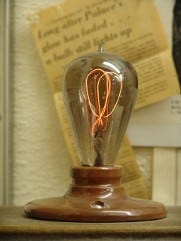
The Fort Worth Palace Theater Light. (Photo from Stockyards Museum)
Interestingly (well, I thought so), both bulbs were made by the Shelby Electric Company. The company no longer exists as such, but is recognized at the Shelby Museum of History in Shelby OH.
Thomas Edison didn’t invent the light bulb, the museum points out. That honor goes to John Wellington Starr of Cincinnati OH, who invented his lamps around 1850. But it was Edison and Joseph Swann of England who developed the process to the point where it could be easily manufactured. Edison was the more successful marketing genious.
The long-lived bulbs, as well as all early bulbs, had carbon filaments encased in a strong vacuum, had brass parts and were all hand made. Edison’s Menlo Park NJ lab produced more than 130,000 lamps, the Shelby Museum says.
So why aren’t incandescent bulbs still made with carbon filaments (assuming incandescent bulbs were still a thing in these days of LED bulbs)?
Well, despite the longevity of the subjects herein, carbon filaments have a notoriously short lifespan, produce a low-level amount of light, which is orange-yellow (remember low-power sodium vapor street lights? Like that), and are very energy inefficient, Wikipedia says.
The bulbs we’re mentioning here are that long lived primarily because they are operated at a low wattage (and are consequently quite dim) and are, well, babied. The two here are 30 watters running at less than 10.
But they originally were bright.
“If it had to light that back stage door _ a dark area _ it had to burn bright,” Sarah Biles, the Stockyards Museum’s administrator, told RoadsideAmerica.com.
And she said it’s OK to be the second longest lived.
“We think that ours has a lot of personality, so it doesn’t really bother us that there’s one a little older,” she said. “We win the personality contest.” (Roadside America)
There are some other long lived bulbs, none approaching the longevity of Fort Worth’s and California’s, 1000bulbs.com says.
The Kongevognen bulb in Trøndelag, Norway, dates back to 1908 as well. The name translates to the King’s Wagon railway car. Not much is known about the history of the bulb, but it is considered one of the oldest working bulbs. However, and this is important, it is no longer run continually, but is turned on a few times a week. So for the record, it doesn’t count.
There actually is a bulb that was turned on earlier than ours: The Ediswan Light Bulb in England. It first saw light in 1883, but guess what? It wasn’t burned continually, so it doesn’t count, either. It has been used only sporadically. The bulb was passed down to the last known owner, Beth Crook, who said her mother-in-law used to take it to school in 1889. I am not making this up.
And in a bit of historical hornswoggling, Edison himself once had a bulb he called the Eternal Light Bulb which he illuminated in 1929 and was, he said, designed to last forever. But when the bulb’s home, the Thomas Edison Memorial Tower in Metuchen NJ, came tumbling down in the 1930s, it was discovered that the bulb was, in fact, hollow, appearing to shine because of the light from four automotive headlights piped up through a tube. Well played, Tommy!
Texas Weird Facts of the Day:
The Palace Theater light was originally installed on Sept. 21, 1908, by stagehand Barry Burke, thus earning himself a minor role in history. It was the outside illumination for the backstage door. When the theater was slated for demolition in 1977, local resident George Dato got it and, recognizing its history, preserved it. The Stockyards Museum took it in 1991 and displayed it in a glass case with its own power supply (still subject to power failures though). (AtlasObscura.com).
A factor in the longevity of all these bulbs (aside from being operated at lower-than-rated wattage) is continual use. The filaments expand and glow when power is applied to them. When darkened, the filaments contract and can sustain tiny cracks, which build up over time and cause them to break. Continually powered, they suffer less damage. (1000Bulbs.com)
How to make your bulbs last almost forever: Buy LEDs.
Today’s Question:
What famous radio commentator would give the Palace Light Bulb birthday wishes at one time? Bonus question: What was his actual name? Answers below:
Notes:
https://www.azquotes.com/quote/1325587?ref=light-bulb
https://texashighways.com/culture/the-fort-worth-light-bulb-that-never-goes-out/
https://www.roadsideamerica.com/story/13049#google_vignette
https://www.shelbyohiomuseum.com/ShelbyMuseum3.html
And the Answer:
The Palace Theater light once got annual birthday wishes from none other than ABC radio broadcaster Paul Harvey. Bonus answer: His full name was Paul Harvey Aurandt, born in Tulsa in 1918. He died in 2009 and is buried in Forest Park IL. Posthumously he still has a connection to Fort Worth in a roundabout way. A couple of clips from his broadcasts were used in the first season finale of Landman, the Paramount+ streaming series largely written and produced by Fort Worth’s Taylor Sheridan. Paramount is currently being sued by Paulynne, Inc, which owns the rights to Harvey’s properties, claiming the clips were used without permission. (Wikipedia) And that’s the rest of the story.
Next: Skeeters!
Thanks for reading! Subscribe for free (or paid) and get Weirded right in your inbox!